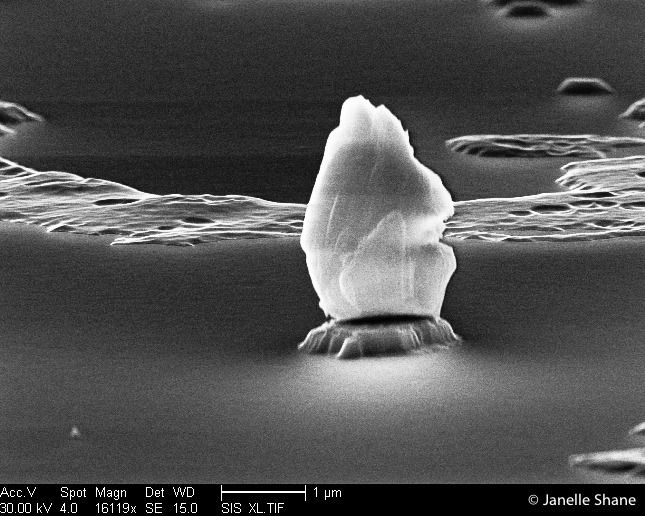
A speck of dust sits on a pedestal - this is a smallish piece of dust, only
about 1/100 the thickness of an average human hair. The dust made its own
pedestal by protecting a small area from the high-energy plasma that I was using
to etch away the
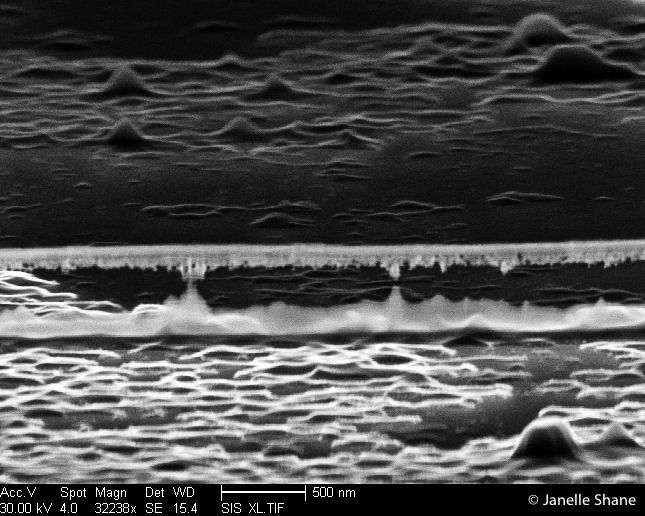
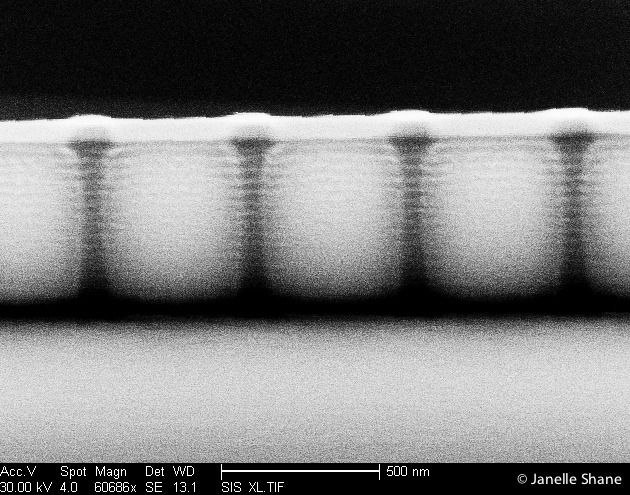
Nanoscale forces work in non-intuitive ways sometimes. This wall of
semiconductor was plasma-etched so thin that the middle was etched entirely
away, leaving the wall’s top floating eerily above void. It’s thin and lacy, and
only touches the wall’s bottom in a few delicate places,
Nanoscale forces work in non-intuitive ways sometimes. This wall of
semiconductor was plasma-etched so thin that the middle was etched entirely
away, leaving the wall’s top floating eerily above void. It’s thin and lacy,
and only touches the wall’s bottom in a few delicate places,
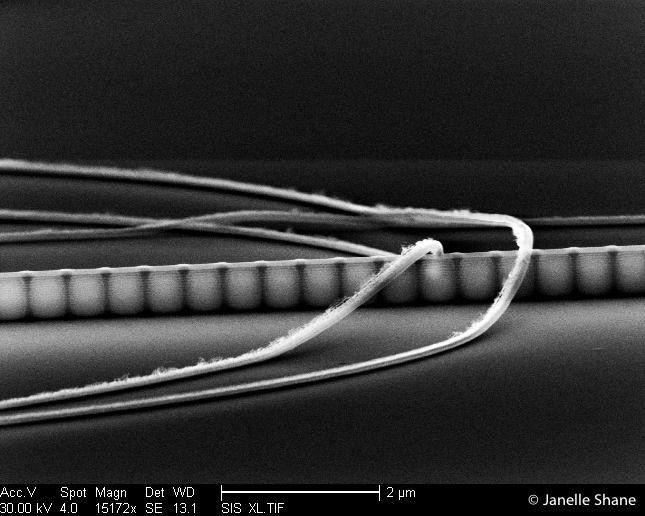
String! I definitely wasn’t expecting to see this - it startled me when I first
came across it, partly because it was looping up dramatically into midair before
it sagged, as I watched, under the glare of the microscope’s electron beam. It
came to rest draped over one of
String! I definitely wasn’t expecting to see this - it startled me when I first
came across it, partly because it was looping up dramatically into midair before
it sagged, as I watched, under the glare of the microscope’s electron beam. It
came to rest draped over one of
Looking like architectural columns, these structures are more than two million
times shorter than their life-sized counterparts. Put another way, they’re only
knee-high to a bacterium - the only way we can see them is with a powerful
electron microscope.
We’re not making buildings with these structures,
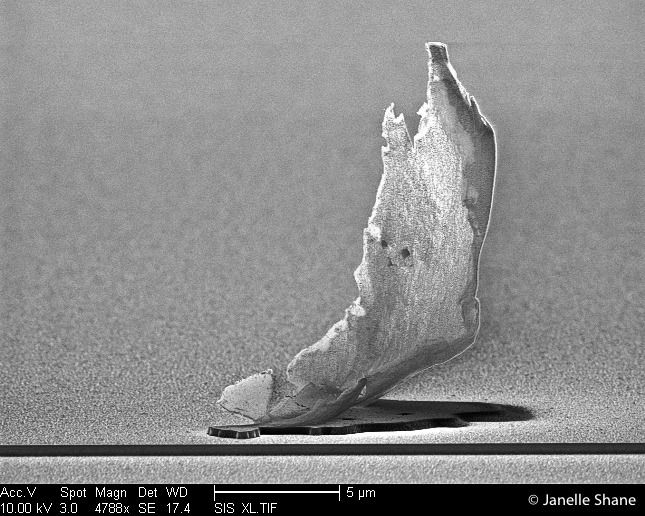
Here’s another example of what happens when dust lands on my sample just before
the etching phase. The giant wing-like airy structure is the dust - due to the
odd way nanoscale forces work, this fragile thing remains upright and intact
even after the sample’s tilted and jostled.
Here’s another example of what happens when dust lands on my sample just before
the etching phase. The giant wing-like airy structure is the dust - due to the
odd way nanoscale forces work, this fragile thing remains upright and intact
even after the sample’s tilted and jostled.
Three views of the same flasks of fluorescent rhodamine dye. At the far right is
a picture of how the flasks look under regular room lights. In the middle, the
scene is illuminated by a UV-emitting flashlight (otherwise known as a
blacklight). Under this strong, high-energy illumination, the