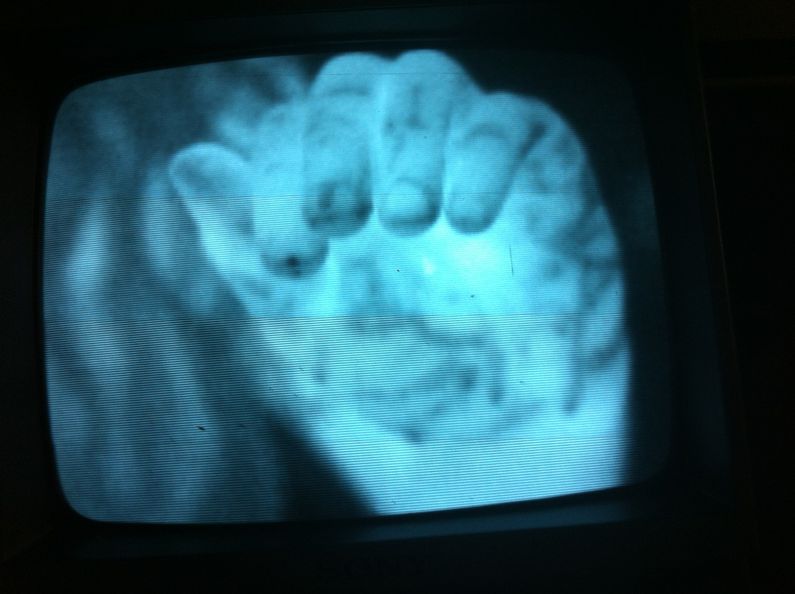
It’s just water. Cold water on a warm hand, to be exact.
This is an image from an infrared camera I was testing today. It turns out that
humans glow in infrared, exactly in the same way that a red-hot piece of iron
glows in visible light. We’
Here’s another view of the sample I posted earlier, the one that was so
wonderfully, spectacularly ruined.
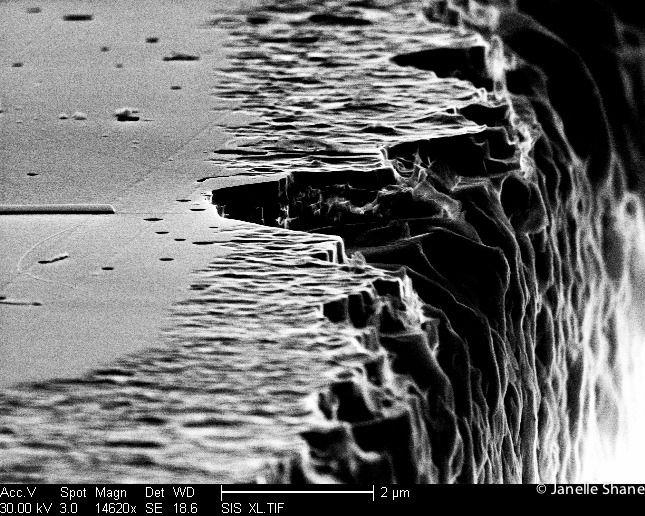
This time I’ve zoomed in near the very edge of the chip, where the vast plain of
laser material abruptly ends at a jagged cliff. By the time I was looking
Here’s another view of the sample I posted earlier, the one that was so
wonderfully, spectacularly ruined.
This time I’ve zoomed in near the very edge of the chip, where the vast plain of
laser material abruptly ends at a jagged cliff. By the time I was looking
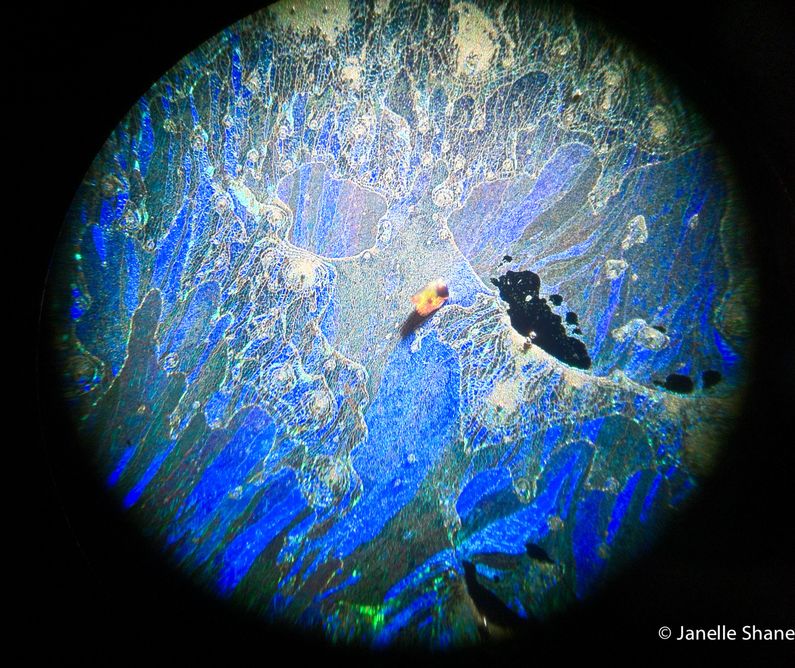
Check it out - we made opal!
My labmate Lindsay Freeman [http://emerald.ucsd.edu/Members/Lindsay.html] made
this thin layer of opal on glass, and this is what it ends up looking like under
a microscope - crazy patterns and planes of swirled color, some areas calm, some
areas highly
Check it out - we made opal!
My labmate Lindsay Freeman [http://emerald.ucsd.edu/Members/Lindsay.html] made
this thin layer of opal on glass, and this is what it ends up looking like under
a microscope - crazy patterns and planes of swirled color, some areas calm, some
areas highly
I was pretty sure this was going to be another doomed sample.
For one, none of those little mesas and bumps - all formed of semiconductor
laser material - were supposed to be there. It was all very interesting-looking,
but it meant that some kind of junk had gotten on my
I was pretty sure this was going to be another doomed sample.
For one, none of those little mesas and bumps - all formed of semiconductor
laser material - were supposed to be there. It was all very
interesting-looking, but it meant that some kind of junk had gotten on my
Sometimes our samples get visitors.
In most cases, they’re simply little flecks of dust that have settled to the
surface of our chips. Since most of the structures we’re making are so small,
your average chunk of dust can be comparatively building-sized.
They usually scare the willies
Sometimes our samples get visitors.
In most cases, they’re simply little flecks of dust that have settled to the
surface of our chips. Since most of the structures we’re making are so small,
your average chunk of dust can be comparatively building-sized.
They usually scare the willies
It’s a serene sight - a nicely formed wall of laser material (semiconductor
InGaAsP, to be exact) stands on a smooth glassy plain.
I added the color - it’s not actually cold here. It’s inhospitable in a
different sense, though: There isn’t any air. For the electron microscope